 EN
EN

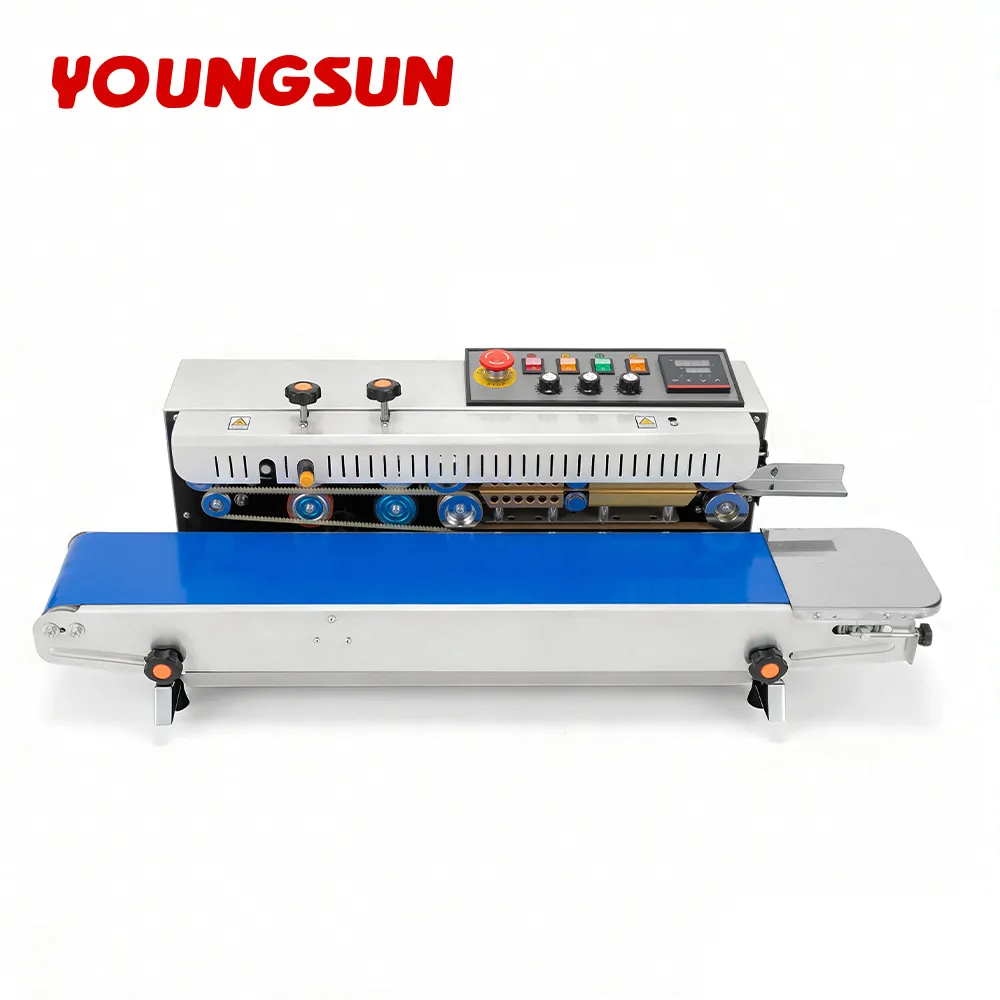
The Hidden Precision Requirement in Heat Sealing
A band sealer appears deceptively simple — two rotating belts convey a filled bag through a heated sealing zone. The apparent simplicity masks a precision dependency: if the bag enters even slightly misaligned, the seal drifts off-center, wrinkles form, or the seal misses the opening entirely. Alignment determines whether the result is a hermetic seal or a rejected product.
What Happens When Alignment Fails
A bag feeding into a band sealer at a 2-degree angle may not trigger an alarm, but consequences compound. The seal track drifts diagonally across the opening rather than running parallel to the edge. On one side, the seal approaches dangerously close to the fill line, risking product contamination of the sealing zone. On the other, excess material beyond the seal creates an unsealed lip that catches on conveyors and accumulates debris.
At production speeds of 40 to 60 bags per minute, a persistent misalignment generates a 3 to 5 percent reject rate — translating to 700 to 1,200 rejected bags over a single shift. The labor to inspect, rework, and repackage those rejects often exceeds the original sealing operation cost.
The Physics of Bag Positioning
Alignment depends on three interacting forces: guide rail geometry, belt grip pressure, and the bag’s structural rigidity. Flexible pouches with low fill levels collapse unpredictably at the infeed throat. Heavy, liquid-filled bags develop momentum that overcomes standard guide rail friction. Gusseted bags expand asymmetrically as they approach the band sealer opening, shifting the centerline. Alignment that works for a 100-gram dry snack pouch fails for a 500-gram frozen vegetable bag with irregular piece geometry.
Engineering Solutions for Consistent Alignment
Mechanical Guide Systems
Adjustable guide rails with fine-pitch positioning — sub-millimeter adjustments — provide the foundation. Rails should extend at least 150 millimeters upstream of the band sealer entry, giving bags sufficient distance to stabilize before entering the sealing zone. Spring-loaded side guides compensate for minor width variations without constant readjustment, critical for co-packing operations running multiple SKU formats.
Active Feeding Mechanisms
Belt-driven infeed conveyors synchronized with the band sealer belt speed eliminate the differential that pulls bags out of alignment at the handoff. Encoder-based synchronization ensures infeed and sealer belts operate at identical surface speeds. Youngsun Equipment’s band sealer designs incorporate this approach using servo-driven conveyors that match sealer belt speed within 0.5 percent tolerance.
Sensor-Based Detection
Photoelectric sensors at the infeed throat detect misaligned bags before the heating zone. When offset exceeds 3 to 5 millimeters from centerline, a pneumatic diverter removes the bag from the product stream. This prevents a single misaligned bag from causing cascade failure where product contamination forces a line stoppage for cleaning.
A Practical Case: Snack Food Co-Packer Solves Chronic Seal Rejects
A contract packaging operation in the UK Midlands running multiple snack brands on a single band sealer line faced a 6.2 percent seal reject rate — nearly double the industry benchmark of 3 to 3.5 percent. Root cause analysis traced 80 percent of rejects to inconsistent bag feeding alignment. The operation handled bag widths from 120 to 240 millimeters and fill weights from 50 to 500 grams.
The co-packer retrofitted the band sealer with an active infeed system featuring encoder-synchronized belts and spring-loaded guides with laser alignment indicators. Operators could verify alignment against a projected centerline within seconds during changeovers. Within four weeks, the reject rate dropped to 2.1 percent. Rework labor decreased by 65 percent, freeing two workers per shift. Retrofitting cost was recovered through labor savings and reduced product giveaway in under eight months.
Selecting and Maintaining a Band Sealer for Alignment
Machine Selection Criteria
A band sealer with independent infeed conveyor speed control enables precise alignment rather than relying on fixed mechanical linkage. Guide rail positioning with digital readouts enables repeatable setup — operators record and recall position values rather than estimating visually. Heated sealing band width should exceed the widest bag opening by at least 10 millimeters per side to accommodate minor variation.
Operational Best Practices
Guide rail calibration should be verified at shift start and after each product changeover using a go/no-go gauge bar machined to target bag width. Belt tension should be measured monthly — stretch over time creates speed differentials that reintroduce alignment drift. Documented setup parameters for each SKU eliminate operator-to-operator variation. ISO 12100 machinery safety standards inform guard placement around infeed and heating zones.
Frequently Asked Questions
Why does bag alignment matter for band sealer performance?
Misalignment causes off-center seals, wrinkles, and incomplete closures. Even a 2-degree offset produces seals that drift toward the fill line or leave excess unsealed material, increasing reject rates and rework costs.
How can operators verify correct bag alignment on a band sealer?
Laser alignment guides projecting a centerline onto the infeed conveyor provide instant visual confirmation. Manual verification uses a go/no-go gauge bar at guide rail entry. Photoelectric sensors automate misalignment detection and rejection.
What causes alignment drift during continuous band sealer operation?
Belt stretch creates speed differentials between infeed and sealer belts. Guide rail fasteners vibrate loose on high-speed lines. Accumulated product dust reduces belt grip. Regular calibration and cleaning address each drift source.
Can a band sealer handle bags of different widths without constant adjustment?
Spring-loaded side guides and programmable rail positioning enable rapid width changes. Manufacturers like Youngsun Equipment offer band sealer configurations with digital position memory, allowing operators to recall saved settings per product.
How does bag fill weight affect alignment in a band sealer?
Heavier bags develop momentum and overcome standard guide rail friction. Lighter bags collapse at the infeed throat, losing structural rigidity for positioning. Infeed conveyor speed and guide rail pressure must adjust for weight extremes.
What maintenance prevents alignment-related band sealer failures?
Weekly guide rail calibration with gauge bars, monthly belt tension measurement, and daily belt surface cleaning maintain alignment. Documented SKU setup parameters prevent operator-to-operator drift during changeovers.
