EN
EN

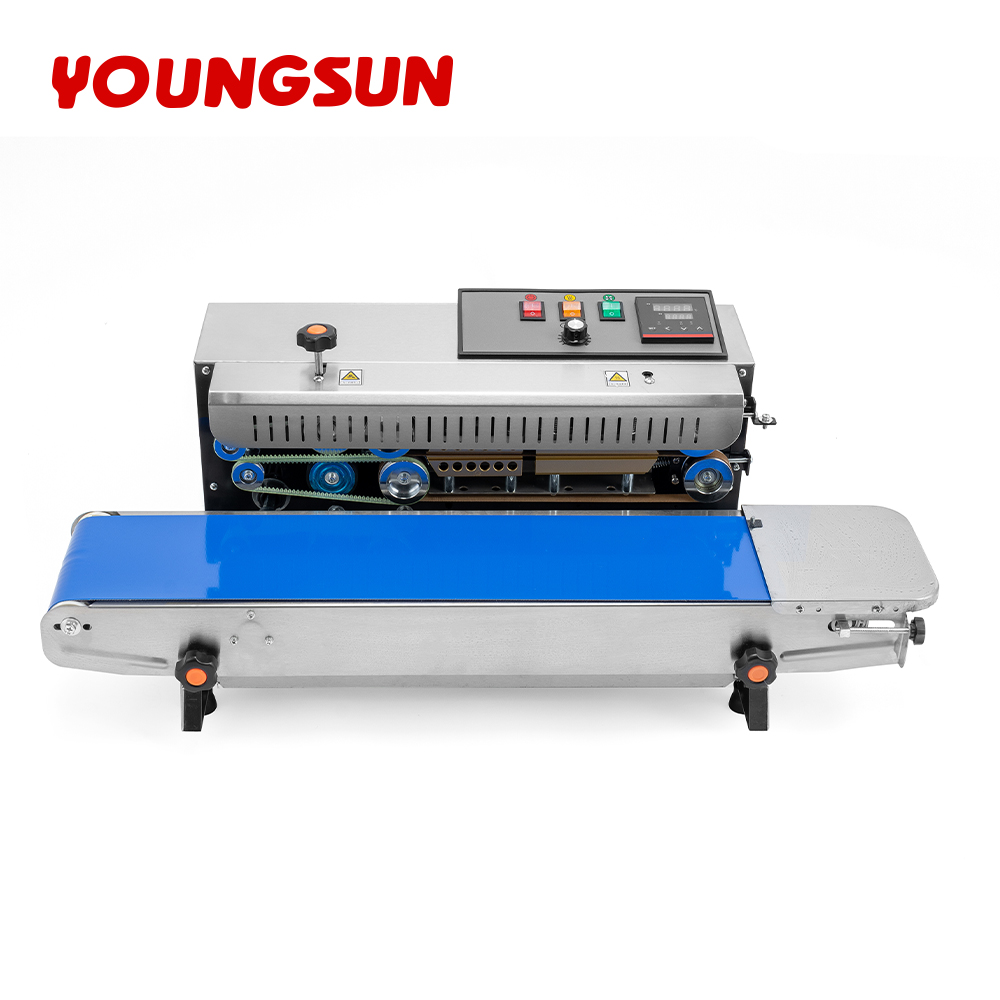
What a Band Sealer Does for Coffee Packaging
A Band Sealer is a continuous heat-sealing machine that feeds filled pouches between two moving PTFE-coated belts through a heated sealing zone. Unlike an impulse sealer sealing one pouch at a time, a band sealer runs continuously — bags enter, pass through heated belts fusing the film layers, and exit sealed. For coffee roasters, the difference is packaging 60 bags per hour versus 600.
Continuous Sealing, Nitrogen Flushing, and Freshness
A coffee-specific Band Sealer integrates nitrogen flushing: a nozzle at the pouch opening injects nitrogen milliseconds before the belts close, displacing oxygen that would oxidize coffee oils within days. The seal forms immediately after the flush, trapping inert atmosphere inside. The operator feeds pouches steadily — 5 to 15 per minute — and the machine seals and flushes each one without stopping. Temperature, belt speed, and nitrogen flow are set once and stay consistent across the entire run.
Real-World Case — A Micro-Roastery Scales Up
A Portland specialty roastery producing 500 pounds weekly sealed 12-ounce valve bags with a foot-operated impulse sealer at approximately 60 bags per hour. Nitrogen flushing was manual with a gas wand — residual oxygen varied from 2% to 8%. The roastery invested in a high-speed Band Sealer with integrated nitrogen flush and bag-top trimmer. Production increased to 400 bags per hour. Residual oxygen stabilized below 2% because flush timing and flow rate were machine-controlled. Wholesale accounts reported noticeably longer shelf stability, and equipment cost was recovered in under 8 months through increased capacity.
Why Coffee Roasters Need Speed and Seal Integrity
Degassing Valves, Film Compatibility, and Oxygen Barrier
Fresh-roasted coffee releases CO₂ for days after roasting. A Band Sealer must produce a seal strong enough to withstand internal pressure from degassing without the one-way valve being the only pressure release mechanism. Seal strength exceeding 30 N/15 mm is required for coffee bags to survive handling, stacking, and the vibration of shipping. Film compatibility spans a wide range: kraft paper with PLA liner, metallized PET/PE laminates, and foil/PE structures. Digital PID temperature control with ±1°C accuracy is essential — a 5°C overshoot scorches the outer kraft layer; a 5°C undershoot produces a weak seal that opens during transit.
High-Speed Band Sealer Configurations
Single-Belt, Double-Belt, and Nitrogen-Flush Integration
A single-belt Band Sealer uses one heated belt pair — suitable for flat pouches and low-to-medium volume coffee operations where stand-up or gusseted bags are not in the product mix. A double-belt configuration adds a second heated belt pair above the first, sealing both the top and bottom of gusseted or stand-up pouches in a single pass — essential for coffee roasters packaging in quad-seal or side-gusset bags where a single belt cannot reach the bottom gusset fold. Nitrogen-flush integration requires a gas nozzle positioned precisely at the pouch opening, a solenoid valve timed to inject gas immediately before the belts close, and a flow meter maintaining consistent flow rate regardless of line speed variation. The gas injection timing is typically triggered by a photoelectric sensor detecting the pouch leading edge.
Selecting a Band Sealer for Coffee Operations
Five Specifications for Roastery Packaging Lines
First, pouch size range and material — from 2-ounce sample bags to 5-pound bulk bags across all film structures. Second, throughput in pouches per minute determines belt speed and motor power. Third, nitrogen flush requirement — verify injection timing accuracy and compatibility with the nitrogen supply. Fourth, seal width — 10 mm to 15 mm for heavy bags, 6 mm to 8 mm for retail formats. Fifth, coding integration — inline date coder printing roast date on the seal area. Youngsun, with a strong track record in packaging solutions, engineers Band Sealer machines configured for the specific demands of coffee roastery production.
Frequently Asked Questions
What is a band sealer in coffee packaging?
A Band Sealer is a continuous heat-sealing machine that feeds filled coffee pouches between two moving PTFE-coated belts through a heated sealing zone, fusing the film layers as the pouch moves through. Unlike manual impulse sealers, it runs continuously — 5 to 15 pouches per minute — with consistent seal quality and optional integrated nitrogen flushing. Youngsun offers band sealers configured specifically for coffee roastery production environments.
Why do coffee roasters need nitrogen flushing?
Fresh-roasted coffee oxidizes rapidly — aroma degrades, oils go rancid. A Band Sealer with integrated nitrogen flushing displaces headspace oxygen with inert nitrogen immediately before sealing, extending shelf life from weeks to months.
What bag materials can a band sealer handle?
Coffee roasters use kraft/PLA, metallized PET/PE, and foil/PE laminates. A Band Sealer with digital PID control accommodates sealing temperatures from 100°C to 180°C across all coffee bag film structures.
What is the difference between single-belt and double-belt band sealers?
Single-belt Band Sealer machines seal flat pouches in one pass. Double-belt configurations seal both top and bottom of gusseted pouches simultaneously — essential for quad-seal and side-gusset coffee bags.
How fast can a band sealer run?
A roastery Band Sealer runs at 5 to 15 pouches per minute — 300 to 900 per hour — depending on pouch size. Speed is limited by operator feeding rate, not machine capability.
How consistent is nitrogen flushing with a band sealer?
A Band Sealer with sensor-triggered nitrogen flush and flow meter control achieves residual oxygen consistently below 2% — far more uniform than manual gas wand flushing where oxygen varies from 2% to 8%.