EN
EN

Understanding the Two Technologies
A rice mill packaging 5-kilogram bags at 15 units per minute has fundamentally different requirements from a jerky producer sealing 200-gram pouches for extended shelf life. Both package dry food. The right machine for one may be entirely wrong for the other. The choice between a band sealer and a vacuum sealer comes down to throughput, oxygen sensitivity, and what "dry food" means in a specific production context.
How a Band Sealer Works
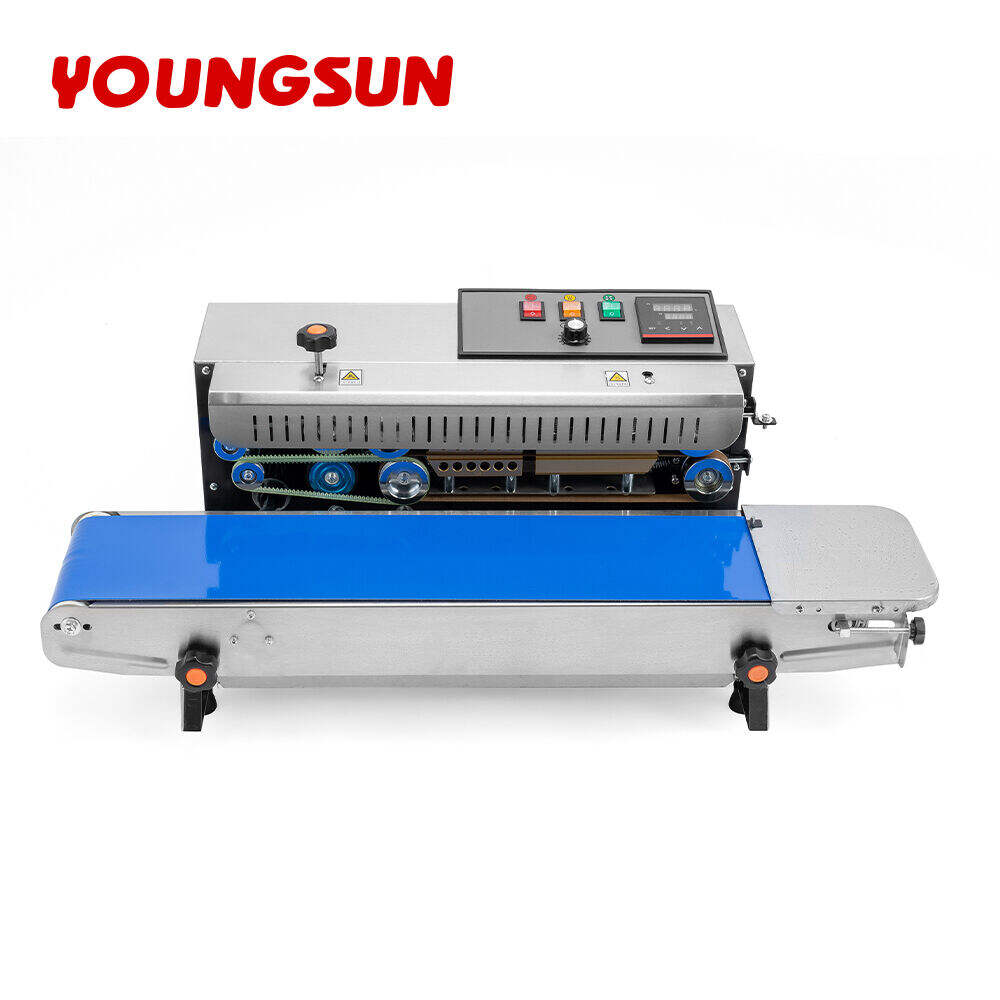
A band sealer continuously heat-seals pre-filled bags. The operator places the open end of a filled bag onto parallel conveyor belts that pull it through a heating zone at constant speed. Heated sealing bars fuse the inner polyethylene layer under controlled temperature and pressure. The belts carry the bag through a cooling zone where the seal solidifies before exit. Speed defines the advantage: 10 to 25 bags per minute in manual-feed configurations, with no cycle time, no vacuum chamber, no dwell period. Throughput is limited only by how fast filled bags arrive at the infeed.
How a Vacuum Sealer Works
A vacuum sealer operates on a batch cycle. The filled bag goes into a chamber, the lid closes, and a vacuum pump extracts air before heat-sealing bars close the bag under vacuum. The cycle — evacuate, seal, vent — takes 15 to 45 seconds, producing 2 to 8 bags per minute. The advantage is oxygen removal, extending shelf life of oxygen-sensitive foods — nuts, coffee, dried meats — from weeks to months by eliminating the oxygen that drives oxidation and mold growth.
Real-World Decision Factors for Dry Food
Throughput and Shelf Life — The Core Trade-Off
A single-nozzle vacuum sealer produces roughly 2 bags per minute; a conveyorized model reaches 4 to 8. A band sealer runs 10 to 25 bags per minute. For 10,000 bags per shift, the gap between 5 and 20 bags per minute is the difference between multiple machines and shifts versus one machine in one shift. The trade-off is shelf life. If the dry food is oxygen-sensitive and needs months of ambient stability, vacuum sealing is required. If the product is inherently stable — rice, dried beans, sugar — the extended shelf life from vacuum sealing offers no practical value, and a band sealer delivers far higher throughput at lower cost.
Real-World Case — Rice Packer Switches Technology
A Southeast Asian rice packer used two chamber vacuum sealers packing 5-kilogram woven PP bags at 7 bags per minute each — 14 bags per minute total with four operators. Vacuum pump maintenance averaged 6 hours downtime monthly per machine. Replacing both with a single continuous band sealer with automated trimmer and coder raised output to 18 bags per minute with one operator. Maintenance dropped to belt cleaning and occasional heating element checks — under 1 hour monthly. For rice, stable at 12 to 18 months in woven PP at ambient temperature, the switch eliminated cost without reducing quality.
Matching Technology to Product
When a Band Sealer Is the Clear Choice
A band sealer is correct when three conditions hold: the dry food is not oxygen-sensitive at its intended storage duration, the packaging has a heat-sealable layer (LDPE, PE-lined woven PP, multi-layer laminate with PE), and throughput above 10 bags per minute is needed. Applications: rice, flour, sugar, salt, dried beans, lentils, granular animal feed. Vacuum sealing is necessary when the product contains fats subject to oxidation — nuts, coffee, dried meats, cheese powders — or when shelf life beyond 3 to 6 months is a customer requirement.
Making the Right Selection
Five Questions Before Choosing
First, is the product oxygen-sensitive? If yes, vacuum sealing is required regardless of throughput. Second, what is the target bags per minute? Below 5, a vacuum sealer works; above 10, a band sealer becomes practical for non-oxygen-sensitive products. Third, what bag material? Both require a heat-sealable inner layer; vacuum sealing adds the requirement that material resists pinholes under compression. Fourth, what is the target shelf life? Products needing 12 months or more should be evaluated for vacuum sealing. Fifth, what is the total cost of ownership? Vacuum pumps need oil changes and gasket replacement; band sealers need belt tensioning and heating element checks.
The choice between a band sealer and a vacuum sealer is about which technology aligns with the product's sensitivity, throughput, and shelf-life expectations — not which technology is "better."
Frequently Asked Questions
What is the main difference between a band sealer and a vacuum sealer?
A band sealer continuously heat-seals pre-filled bags through heated bars on conveyor belts — fast, continuous, high throughput. A vacuum sealer removes air from inside the bag before sealing in a batch chamber cycle — slower, but extends shelf life by eliminating oxygen.
Which dry foods need vacuum sealing instead of band sealing?
Oxygen-sensitive foods — coffee beans, nuts, dried meats, cheese powders, dehydrated fruits — need vacuum sealing because oxygen removal extends shelf life from weeks to months. Rice, flour, sugar, and salt are not oxygen-sensitive at normal storage durations.
How fast can a band sealer operate compared to a vacuum sealer?
A band sealer operates continuously at 10 to 25 bags per minute. A chamber vacuum sealer produces 2 to 8 bags per minute per chamber. The throughput difference can be 3x to 10x for non-oxygen-sensitive products.
Can a band sealer be used with woven polypropylene rice bags?
Yes, woven PP bags with an inner PE liner or PE coating are compatible with band sealer operation. The PE layer melts under heat and pressure to form the seal. Uncoated woven PP requires sewing or ultrasonic sealing.
What maintenance does a band sealer require?
Routine maintenance includes cleaning belts of product dust and film residue, checking belt tension, inspecting heating elements, and verifying cooling zone function. Typical monthly maintenance takes under one hour — significantly less than vacuum pump oil changes and gasket replacement.
How does bag material affect the decision between band sealer and vacuum sealer?
Both machines require a heat-sealable inner layer, typically PE. Vacuum sealing adds the requirement that the bag must resist collapsing or developing pinholes under full vacuum. Multi-layer laminates with nylon or PET outer layers provide puncture resistance needed for vacuum packaging but may seal differently than simpler PE films used in band sealer applications.