 EN
EN

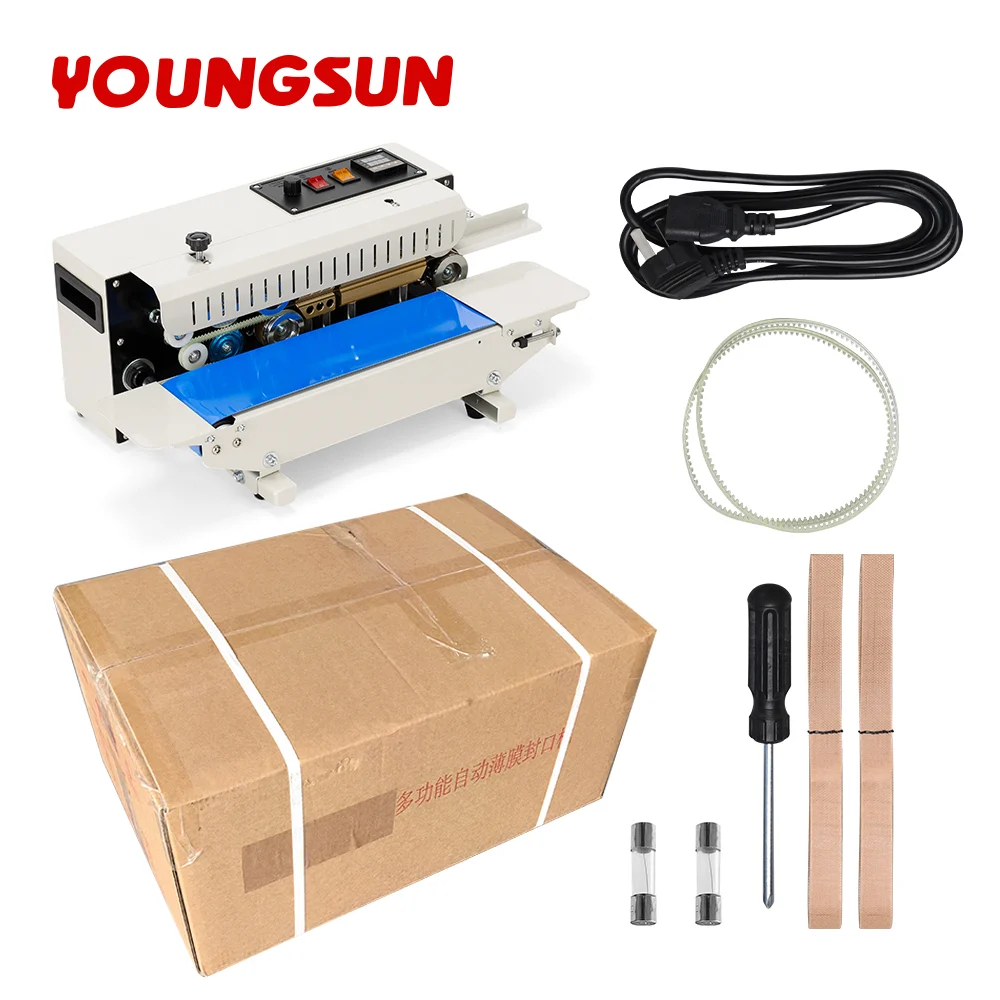
Speed Gap: Throughput Comparison Between Continuous Band Sealer and Manual Sealing
Real-World Performance: 60–120 bags/minute vs. 5–15 bags/minute
A continuous band sealer routinely processes 60 to 120 bags per minute—depending on bag size, film type, and thickness—while a skilled manual operator achieves only 5 to 15 bags per minute using a hand-held heat sealer. This represents an 8:1 to 12:1 speed advantage, translating directly into five- to ten-fold higher line output. Over an 8-hour shift, manual sealing yields approximately 2,400 to 7,200 finished bags; the same timeframe sees a single band sealer deliver 28,800 to 57,600 sealed units. The gap widens with scale: unlike manual methods, the band sealer’s conveyor-fed, continuous motion eliminates cycle-time delays for bag placement, alignment, or dwell-time adjustment. Its consistent heat application and pressure produce uniform seals at full speed—slashing per-bag labor cost and removing the sealing bottleneck that constrains food, pharmaceutical, and industrial packaging lines.
Root Cause Analysis: Human biomechanics and task-switching bottlenecks in manual sealing
Manual sealing hinges on a repetitive physical sequence: grasp a filled bag, position it on the sealer, depress the sealing bar, wait for the heat cycle, release, and stack. Biomechanical limits cap this cycle at 4–12 seconds—even under ideal conditions—due to arm speed, hand-eye coordination, and fine-motor control. Task-switching compounds inefficiency: operators regularly pause to straighten misaligned pouches, clear jams, or inspect seals, adding 2–5 seconds of dead time per interruption. Over an 8-hour shift, muscular fatigue further reduces peak throughput by 15–25%. In contrast, the continuous band sealer replaces human motion with mechanical feed, synchronized heating, and in-line cooling—eliminating stop-and-go rhythm entirely. This enables stable, fatigue-free operation at maximum rated speed while freeing staff to manage upstream filling or downstream packing tasks.
How the Continuous Band Sealer Achieves Uninterrupted Speed
Core Mechanism: Synchronized conveyor, precision-heated band, and optimized dwell time
The continuous band sealer sustains high-speed throughput through three tightly integrated elements: a synchronized conveyor, a precision-heated sealing band (typically PTFE-coated), and electronically controlled dwell time. Bags enter continuously and move through the sealing zone without interruption—unlike stop-start impulse or manual systems. As each pouch passes between the heated bands, uniform pressure and temperature are applied for a precisely calibrated duration, tuned to film thickness and polymer composition. This prevents under-sealing (leaks) or over-sealing (film degradation), ensuring integrity across thousands of units per hour. Because motion is constant and parameter-driven—not operator-dependent—the system delivers repeatable performance at 60–120 bags per minute, turning sealing from a variable human task into a predictable, scalable process.
Smart Integration: PLC-controlled adaptive speed scaling with inline vision systems
Modern continuous band sealers integrate programmable logic controllers (PLCs) and inline vision inspection to enable real-time responsiveness. The PLC monitors upstream equipment—such as fillers, weighers, or labelers—and dynamically adjusts conveyor speed to maintain seamless line synchronization. Simultaneously, vision systems scan every seal for width, continuity, and alignment, feeding quality data back to the controller. If anomalies are detected, the system automatically fine-tunes temperature or dwell time—without stopping production. This closed-loop control removes reliance on manual calibration, prevents slowdowns caused by inconsistent seals, and allows one machine to handle varying pouch sizes and line speeds reliably. As a result, the sealer functions not just as equipment, but as an intelligent, self-optimizing node within the broader packaging ecosystem.
ROI Justification: Quantifying Speed Gains as Operational and Financial Value
Labor reduction: 72% fewer sealing operators and doubled line output
Replacing manual sealing with a continuous band sealer delivers immediate labor efficiency. Where 8–10 full-time operators are needed to sustain 80 bags per minute manually, the same output requires just two personnel—one to manage infeed and one for quality oversight. That’s a 72–75% reduction in direct sealing labor, often the largest variable cost on the line. Crucially, the machine operates at a constant, fatigue-free pace—effectively doubling line output without overtime, shift extensions, or additional staffing. Freed operators can be redeployed to higher-value activities like secondary packaging, palletizing, or in-line inspection, amplifying operational leverage. The net outcome is a marked increase in output per labor hour and a measurable drop in cost per sealed bag.
Payback timeline: <4-month ROI driven by throughput-driven cost absorption
Capital investment in a continuous band sealer typically pays for itself in under four months—primarily through labor savings and throughput gains. For example, replacing six operators at an average fully loaded annual cost of $35,000 each yields $210,000 in annual labor savings. Against a conservative machine investment of $60,000, payback occurs in roughly 3.4 months. Additional value accrues from reduced material waste (consistent seals eliminate rework), lower energy use per unit, and avoided temporary labor during peak demand. Critically, throughput-driven cost absorption drives down fixed-cost allocation: at 80 bags per minute, the machine’s capital cost per thousand sealed bags falls to approximately $0.10—compared to over $0.60 per thousand for manual labor alone. These economics align with findings from a 2023 cross-industry study published by the Packaging Machinery Manufacturers Institute (PMMI), which confirmed that automated sealing systems delivering ≥2× throughput gains achieve positive ROI in under four months—even at 80% utilization. The rapid payback strengthens cash flow and positions operations for agile growth and faster order fulfillment.
FAQ Section
What is the main advantage of a continuous band sealer over manual sealing?
The primary advantage is its significantly higher throughput—up to 120 bags per minute compared to just 5–15 for manual sealing—along with consistent sealing quality and reduced labor costs.
How does a continuous band sealer maintain uniform sealing?
It uses a synchronized conveyor, precision-heated PTFE-coated sealing bands, and electronically controlled dwell time, ensuring uniform pressure and temperature for consistent seal integrity.
Can the continuous band sealer handle different pouch sizes?
Yes, modern band sealers with PLCs and adaptive controls can efficiently handle varying pouch sizes and line speeds without manual recalibration.
What is the ROI timeframe for investing in a band sealer?
The investment typically pays off in less than four months, driven by substantial labor savings, increased throughput, and reduced material waste.
How does a continuous band sealer contribute to operational efficiency?
It minimizes labor dependency, eliminates fatigue-related slowdowns, reduces sealing bottlenecks, and frees employees for higher-value tasks within the production line.
Table of Contents
- Speed Gap: Throughput Comparison Between Continuous Band Sealer and Manual Sealing
- How the Continuous Band Sealer Achieves Uninterrupted Speed
-
ROI Justification: Quantifying Speed Gains as Operational and Financial Value
- Labor reduction: 72% fewer sealing operators and doubled line output
- Payback timeline: <4-month ROI driven by throughput-driven cost absorption
- FAQ Section
- What is the main advantage of a continuous band sealer over manual sealing?
- How does a continuous band sealer maintain uniform sealing?
- Can the continuous band sealer handle different pouch sizes?
- What is the ROI timeframe for investing in a band sealer?
- How does a continuous band sealer contribute to operational efficiency?
