 EN
EN

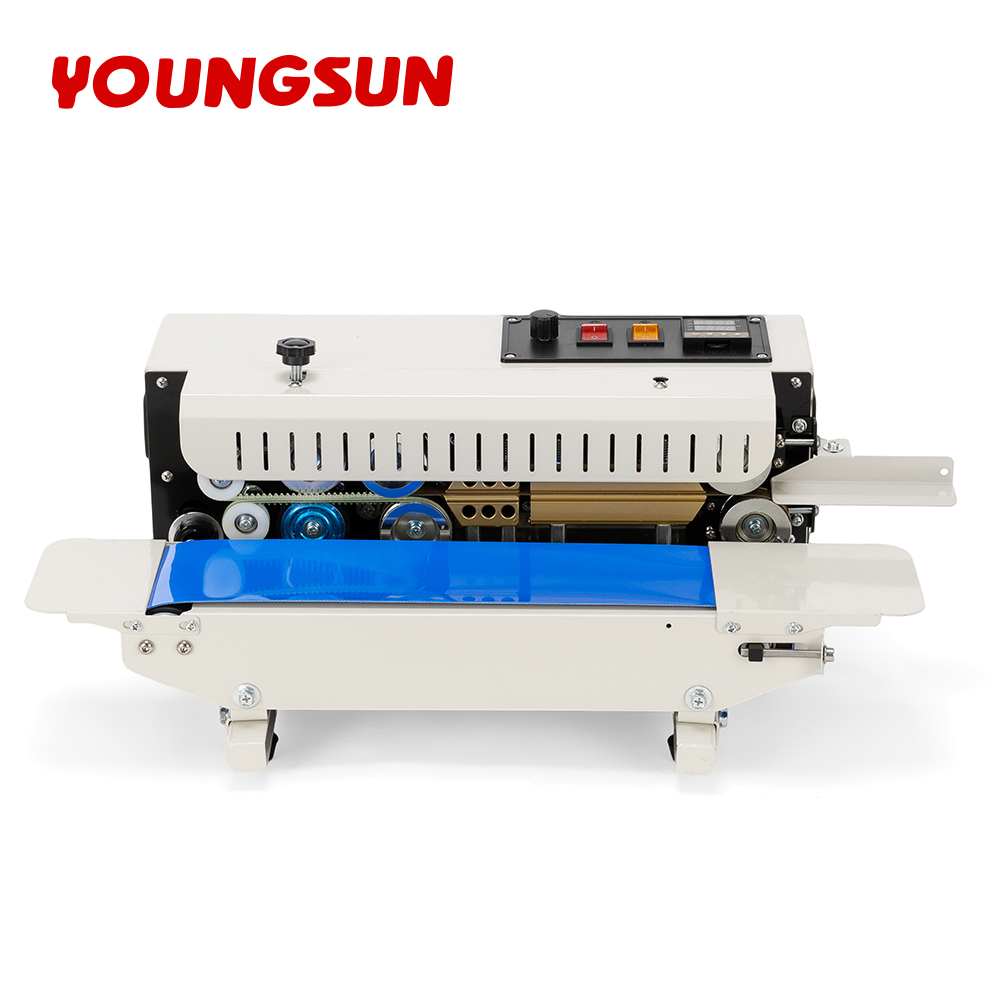
Matching Band Sealer Orientation to Product Type and Bag Configuration
A vertical band sealer and a horizontal band sealer share the same core technology — continuous heat sealing via Teflon-coated belts — but their physical orientation determines which products they can handle without spills, jams, or seal failures. Selecting the wrong orientation creates daily packaging line frustration that no amount of parameter adjustment can fix.
The Orientation Decision: Product Flow vs. Gravity
Horizontal Band Sealers: The Flat-Bag Workhorse
A horizontal band sealer places the heating belts and pressure rollers in a horizontal plane. The operator lays the filled bag flat on the conveyor, and the bag mouth passes between the sealing belts while the bag body rests on the belt surface. This orientation works because gravity holds solid, dry products — snack foods, hardware components, cosmetic sachets, electronic parts — flat and stable inside the bag during transport through the sealing zone.
The horizontal configuration handles bags up to the machine's width rating with consistent seal quality. Models like Youngsun's FR-1000 horizontal continuous band sealer seal bags at 0–12 meters per minute with a 6–12 mm seal width, suitable for film thicknesses up to 0.08 mm single-layer. The horizontal layout integrates naturally with upstream filling stations, where filled bags transfer directly onto the sealer conveyor without reorientation.
The limitation of the horizontal band sealer becomes apparent with non-flat products: pouches filled with liquids, powders, or free-flowing granules shift under conveyor vibration. Bag contents migrate toward the seal zone, contaminating the sealing surface and producing weak or leaking seals.
Vertical Band Sealers: Conquering Gravity-Sensitive Contents
A vertical band sealer orients the heating belts and pressure rollers vertically. The bag hangs from its top edge as the sealing belts grip and transport it, with the unsealed bag mouth at the top. Gravity keeps contents — whether liquid detergent, milk powder, coffee beans, or spice granules — settled at the bag bottom, well away from the seal zone. This orientation eliminates the contamination problem that plagues horizontal sealers with non-solid products.
Vertical band sealers like the FR-900C series incorporate height-adjustable bag guides (typically 11–22 cm adjustment range) that accommodate different pouch sizes. The vertical path allows sealing stand-up pouches, gusseted bags, and liquid-filled sachets that would be impossible to seal horizontally without elaborate fixturing. The trade-off is a slightly more complex bag-loading motion — operators must clip or position the bag top into the vertical guides rather than simply laying it flat.
Technical Factors That Drive Orientation Selection
Seal Quality Differences Between Orientations
The primary seal quality concern in horizontal orientation is consistent pressure across the bag width. A bag containing an unevenly distributed product — hardware parts that settle to one edge, for example — creates a thickness gradient that the pressure rollers must accommodate. Spring-loaded rollers compensate for moderate thickness variation, but extreme gradients produce weak spots in the seal.
Vertical orientation eliminates product interference with the seal zone entirely. The seal forms in clean film above the product level, producing more consistent seal strength across production runs. For high-value products where seal failure means product loss and potential customer returns — pharmaceutical powders, premium food ingredients — the seal consistency advantage of vertical orientation often justifies the slightly more complex bag handling.
Throughput and Integration Considerations
Horizontal band sealers integrate more easily into automated filling lines because bags travel in a straight, flat path from filling to sealing to downstream operations. Conveyor-to-conveyor transfer requires no orientation change. Vertical sealers typically require an operator-mediated transfer from filling to the vertical bag guides, though automated pick-and-place systems for vertical loading exist at higher cost.
A Coffee Roaster's Orientation Decision
A specialty coffee roaster packaging 250g and 500g whole-bean bags evaluated both band sealer orientations for a packaging line upgrade. The horizontal configuration sealed 500g flat-bottom bags reliably at 8 m/min but struggled with 250g stand-up pouches — the lighter bags tipped on the conveyor, spilling beans into the seal zone.
The roaster selected a Youngsun FR-900C vertical band sealer for the 250g pouch line and kept the existing horizontal sealer for the 500g flat bags. The vertical sealer's height adjustment accommodated both pouch sizes when needed for production flexibility. Post-installation, seal failure rates on the 250g line dropped from 4% to under 0.3%, and operator complaints about bean spillage during sealing disappeared.
Frequently Asked Questions
Can a single band sealer handle both vertical and horizontal orientations?
No. The machine frame, belt orientation, and bag guide system are fixed to one orientation during manufacturing. A facility sealing both flat solid-product bags and liquid/powder pouches needs one of each type. Youngsun offers both orientations across its FR series.
What is the maximum bag height a vertical band sealer accommodates?
Standard vertical band sealers handle bag heights from 11 to 22 cm through adjustable guides. Extended-height models accommodate bags up to 30 cm for larger pouches. Confirm the specific model's height specification before ordering.
Do vertical band sealers cost more than horizontal models?
Vertical models typically cost 10–15% more than equivalent horizontal models due to the additional guide mechanisms and more complex frame construction. The price difference is small relative to the cost of seal failures on the wrong configuration.
Which orientation works best for aluminum foil bags?
Both orientations seal aluminum foil laminates effectively. The key factor is the product inside: solid, flat contents favor horizontal; powders, liquids, or granular contents require vertical to prevent seal-zone contamination.
Can band sealers handle gusseted bags?
Yes, both orientations seal gusseted bags. Vertical orientation provides better gusset control because gravity holds the gusset folds open during sealing rather than collapsing under the bag's weight as can happen in horizontal orientation.
What conveyor speed works best for consistent sealing?
Most band sealers seal reliably at 6–8 m/min for standard films. Maximum speed (12 m/min) requires precise temperature control and consistent bag presentation. Operators should start at 6 m/min and increase only after confirming seal quality at each speed increment.
