 EN

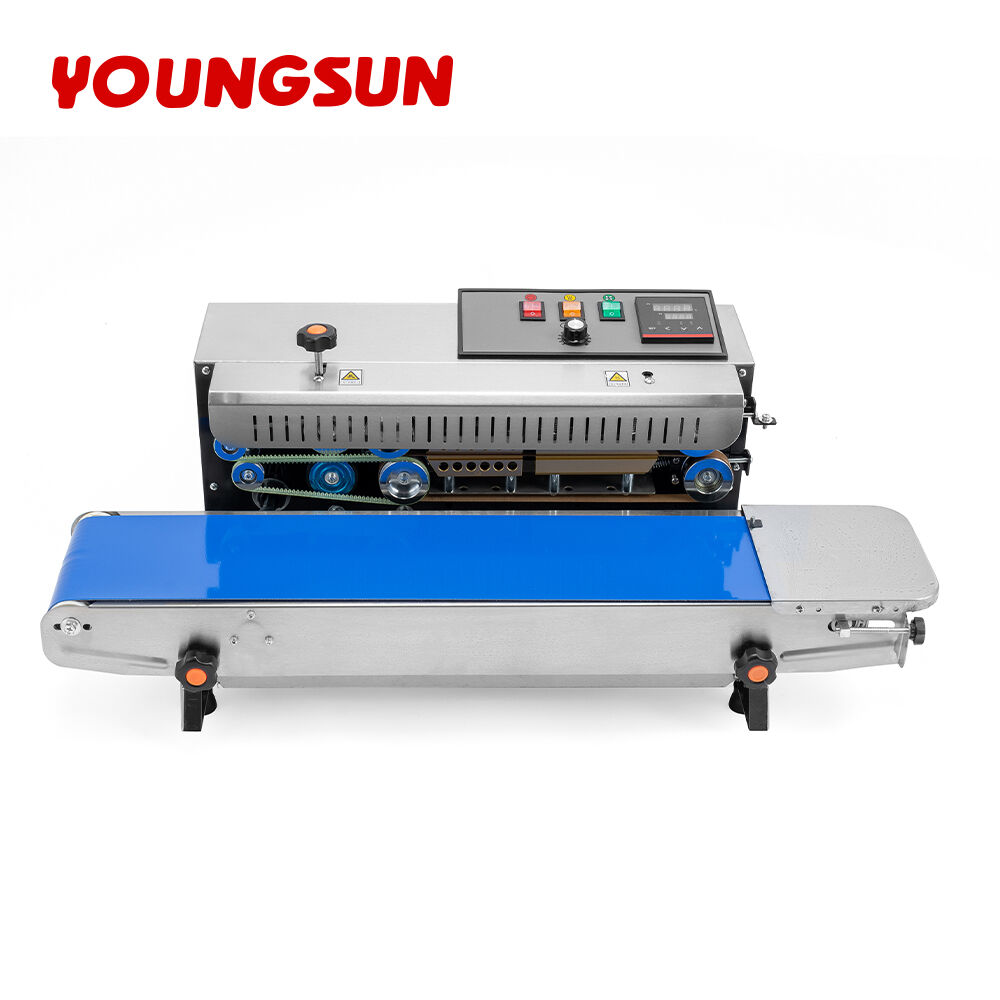
How Dual-Heating Element Design Improves Seal Precision and Consistency
A dual-heating element heat sealer uses active heating circuits on both the upper and lower sealing jaws—unlike conventional designs that rely on one driven jaw and one passive anvil. This symmetrical thermal input reduces through-thickness temperature gradients and helps the seal interface reach its optimal fusion window more rapidly. The result is tighter control over seal width, peel strength, and cosmetic appearance across repeated cycles.
Independent Top-and-Bottom Temperature Control for Uniform Seal Integrity
In single-element impulse heat sealers, the lower jaw typically serves only as a pressure backstop, forcing heat to travel unidirectionally through the film stack. This creates a predictable failure mode: the side adjacent to the active jaw reaches the melt range, while the opposite surface remains cooler—especially with thicker laminates or high-thermal-mass tray flanges. Independent top-and-bottom temperature control eliminates this asymmetry. Each jaw features its own temperature sensor, heater driver, and closed-loop controller, enabling simultaneous, precise thermal management of both sealing surfaces.
Because seal formation depends on molecular interdiffusion at the interface, incomplete thermal activation on either side leads to partial fusion. Uniform bilateral heating shortens the time outer film layers are exposed to excessive temperatures—reducing risks of thinning, shrink-back, or edge deformation. It also makes the process less sensitive to incoming variation in film thickness, contact pressure, and ambient conditions. As a result, consistent seal integrity can be achieved without raising average temperature.
Empirical Performance: 37% Lower Seal Variability vs. Single-Element Impulse Heat Sealers (ASTM F2054-22)
ASTM F2054-22 defines a restrained-plate burst test method for evaluating seal strength consistency. Cross-trial data shows dual-element heat sealers deliver 37% lower seal variability than single-element impulse sealers under identical pressure, dwell time, and temperature setpoints (ASTM F2054-22, 2022). This improvement stems directly from bidirectional thermal activation: by bringing both sides of the interface into the fusion window simultaneously, cold spots and localized overwelding are significantly reduced.
Lower variability reflects more than just improved average strength—it narrows the distribution of outcomes. That means fewer weak seals at the low end and fewer embrittled, distorted seals at the high end. For packaging engineers, this translates into tighter process capability (Cpk), fewer leakers in stability testing, and more reliable shelf-life validation. The independent top-and-bottom control described above is the core mechanism behind this performance gain: minimizing thermal asymmetry between jaws tightens the statistical spread of seal quality.
Dual-Element Heat Sealer vs. Alternative Heat Sealing Technologies
Functional Comparison: Impulse, Direct, and Continuous Heat Sealers
Packaging operations commonly choose among three conventional heat sealing methods: impulse, direct, and continuous. Impulse sealers apply short electrical pulses to a resistive element, offering rapid cooldown ideal for thin, heat-sensitive films—but limiting cycle speed. Direct heat sealers maintain constant jaw temperature, supporting faster throughput on multilayer or thicker materials, yet risking overheating on delicate films. Continuous sealers use moving belts or hot air for inline, high-volume applications but lack flexibility for intermittent or variable-bag runs. A dual-element heat sealer differs fundamentally by integrating independently controlled heating elements on both jaws—enhancing contact uniformity, dwell consistency, and across-the-web seal quality. Key distinctions are summarized below:
| Technology | Heating Mode | Best-Fit Application | Major Limitation |
|---|---|---|---|
| Impulse | Short electric pulse | Thin, heat-sensitive films | Slower cycle speed |
| Direct | Heated jaws at set temperature | Multilayer or thicker films | Overheating risk on thin film |
| Continuous | Moving belt or hot air | High-speed inline packaging | Less flexibility for intermittent use |
| Dual-element | Independent top-and-bottom heating | Precision seals, multilayer, variable films | Higher initial cost and control complexity |
Bridging the Gap: Dual-Element Architecture Combines Responsiveness and Thermal Stability
Conventional single-element sealers often force a tradeoff between responsiveness and thermal stability. Impulse systems react quickly but lose heat between cycles; constant-temperature designs hold steady but respond sluggishly to film changes. Dual-element architecture resolves this by regulating each sealing surface separately. Each element can preheat to a target profile, deliver precise energy during dwell, and recover rapidly after jaw release. This minimizes cold spots that cause weak seals—and hot spots that induce thinning or burn-through. Operators can adjust parameters for varying film gauges without waiting for a large, shared jaw assembly to stabilize.
The outcome is a sealer that supports faster effective cycle times while maintaining the seal zone within a narrower thermal window. For mixed-product lines, this improves repeatability and cuts manual recalibration. It’s especially valuable when sealing coextruded films, high-barrier laminates, or recyclable mono-materials—structures with narrow, non-overlapping processing windows.
Expanded Material Compatibility Enabled by Advanced Dual-Element Heat Sealer Engineering
Dual-heating element design expands material compatibility by allowing top and bottom jaws to operate at different temperatures—a necessity for asymmetric multilayer structures. In such films, a low-melting sealant layer faces one jaw while a higher-melting barrier or structural layer faces the other. Rather than settling on a compromise temperature that risks undersealing or overheating, operators set each jaw near its respective layer’s seal initiation threshold. This yields strong interfacial bonding without distorting the outer ply.
Many conventional impulse, direct, and continuous sealers rely on one-sided heating or conductive transfer—creating a narrow processing window for heat-sensitive monomaterials, recyclable polyethylene structures, or biodegradable films. Dual-element engineering compensates for thermal lag by stabilizing both surfaces independently. As a result, thin films below 40 microns and thick laminates above 150 microns achieve greater consistency, since dwell time and jaw temperature are decoupled.
Compatibility also improves for films with mismatched coefficients of friction or differential shrink orientation. Uneven heating commonly causes curl, tunneling, or weak edge seals; independent top-and-bottom control mitigates thermal asymmetry, ensuring flat, full-width seals. This capability supports critical applications—including medical device pouches, food overwrap with high-barrier layers, and adhesive-free recyclable mono-material packaging.
The benefit extends beyond polyethylene. Coextruded films, metallocene-catalyzed sealants, and laminates incorporating nylon, PET, or aluminum oxide coatings can be qualified with less trial and error. Because the lower-melting side receives only the energy required for fusion, the higher-melting side retains dimensional stability. For converters and packaging lines, this means fewer rejected pouches, lower scrap rates, and greater agility in adopting sustainable film structures.
When to Avoid a Dual-Heating Element Heat Sealer: Key Selection Considerations
Cycle Time Demands, Film Thickness Range, and Operator Proficiency Requirements
A dual-heating element heat sealer is often not the optimal choice when cycle time demands exceed 300 packages per minute. Simultaneous heating of both film surfaces adds dwell and cooling time, so high-speed, thin-film lines may achieve better throughput with a single-element impulse unit that heats only during jaw contact. Film thickness range is another key factor: very thin, low-melt films can warp or scorch under dual-sided thermal input, whereas thick, multi-layer laminates clearly benefit from dual-zone control.
Operator proficiency is equally critical. If staff lack training to independently configure and validate top-and-bottom temperature profiles, mismatched settings may produce weak seals—or worse, burn-through. In such cases, a simpler single-zone sealer reduces setup error and rework. Before committing to dual-element architecture, evaluate actual film gauge, line speed requirements, and operator capability—not just theoretical performance advantages.
FAQs
What is the main advantage of using a dual-heating element heat sealer?
The main advantage is improved seal precision and consistency. The dual heating elements reduce thermal asymmetry by evenly heating both sealing surfaces, enhancing seal width, peel strength, and visual quality.
What kind of materials can benefit most from a dual-element heat sealer?
Films with asymmetric multilayer structures, heat-sensitive monomaterials, recyclable polyethylene, and biodegradable films benefit most because of their narrow processing windows and thermal sensitivity.
What are the limitations of using a dual-heating element heat sealer?
Limitations include slower cycle times for very high-speed operations, a greater likelihood of operator errors in setting top-and-bottom temperatures, and higher initial equipment costs.
When is a dual-heating element sealer not the best choice?
A dual-heating element sealer may not be suitable when cycle times need to exceed 300 packages per minute, when working with very thin low-melt films, or when a simpler, less technical setup is preferred.
How does dual-element design improve material compatibility?
By allowing independent temperature control of the top and bottom jaws, dual-element sealers provide precise thermal management for films with different material properties, such as different melting points or coefficients of friction.
Table of Contents
- How Dual-Heating Element Design Improves Seal Precision and Consistency
- Dual-Element Heat Sealer vs. Alternative Heat Sealing Technologies
- Expanded Material Compatibility Enabled by Advanced Dual-Element Heat Sealer Engineering
- When to Avoid a Dual-Heating Element Heat Sealer: Key Selection Considerations
-
FAQs
- What is the main advantage of using a dual-heating element heat sealer?
- What kind of materials can benefit most from a dual-element heat sealer?
- What are the limitations of using a dual-heating element heat sealer?
- When is a dual-heating element sealer not the best choice?
- How does dual-element design improve material compatibility?
